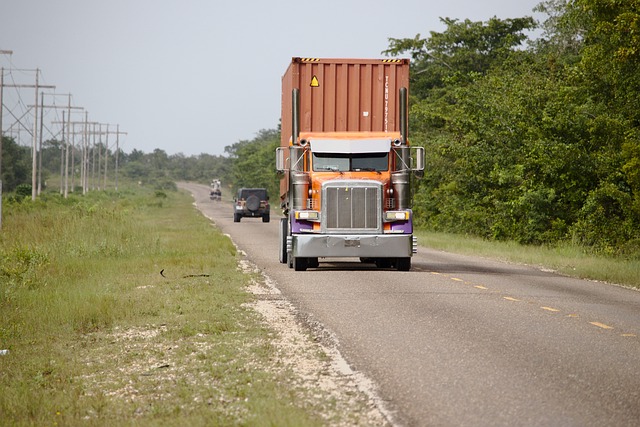
Full Truckload
Full truckload is the most popular for-hire option in terms of market share of 46.4 percent. It doesn’t matter if it’s dry or refrigerated, customers will have faster transit times of their cargo from the point of origin to their destination with this transport method compared to the alternative 53′ capacity intermodal.
Freight is usually constructed and stretched-wrapped on pallets and then loaded onto the trailer to be transported. Shippers may also floor load or utilize slip sheets to load on the trailer for cargo. Slip sheeting and floor loading a trailer can increase the usable cubic foot capacity of a trailer as it permits more products to be loaded due to the reduced space for pallets and the weight of the pallets. In contrast, slip sheeting and floor loading can increase the time required for loading and unloading the product.
When selecting a freight providers, shippers can access a diverse set of options for full truckload import shipping (dry, temperature-controlled or Haz-Mat capacity) through a variety of the top freight brokers and logistics providers, although technology has really allowed freight brokers of all sizes to access the same capacity and price so it gets down to what is the best fit for the company.
Shippers are also able to access the truckload from their own, however there’s a limit on the number of motor carriers they are able to manage on their own.
Freight brokers and logistics service companies (LSP) can be more effective in gaining access to the entire market by using their technology and personnel that can be utilized cost-effectively over more customers and the revenue they earn by using a non-asset model for their business.
There is not only a speed advantage in locating the capacity of a non-asset provider, but also their ability to swiftly check the driver for safety and legal operating authority, as well as placing the carrier under agreement. These are all crucial factors to ensure that the load is placed on the road in a legal manner.
LTL (Less-than-Truckload)
If shippers are faced with freight shipments that aren’t big sufficient to fit the full capacity of a 53′ trailer, they switch into LTL (also known as less than truckload). In this type of transportation the motor carrier is aiming to combine several LTL shipping shipments from several shippers into a 53′ trailer through cleaning regional and local distribution centers. Then, the shipments are returned to the transload dock to load the line hauls to the cities of destination. When the cities of destination are reached the load is transferred to another location at a cross dock before being sent out for local delivery.
There’s additional information about the LTL model that is what is known as hub-and-spoke networks This overview will be sufficient to start you off.
Larger shippers can conduct themselves consolidations using the transportation management software (TMS) platform which optimizes its freight routes and rates in order to create the most cost-effective and efficient load schedule for the day’s shipment.
Freight consolidation can be described as a logistics freight method whereby a shipper blends several LTL shipment within a specific geographical region into a truckload or intermodal . The shipments are then hauled line-hauling to a destination point at which the shipments are dismantled and then shipped LTL until they reach their destination. When using the LTL freight consolidation program comes numerous benefits, which will be discussed later in this article.
Another option for freight service is the expedited. Certain industries depend on expedited freight like medical and JIT operations. This is more costly for shippers, and our suggestion is to take every step that you can to reduce the use of expedited freight, which could include making plans ahead, a better communication , and involving teams in helping them understand the impact this method of transportation can have on their budgets.
As we put the two main modes of freight transportation in the US in the past Let us explore the issues of cost, comparability and other issues related to how shippers use the different OTR (over-the-road) alternatives to improve their supply chain logistics and logistics.
Truckload v. Less-than-Truckload (LTL)
As we’ve mentioned before that no mode of transportation is superior to one over the other. The only way to get diversification is to have a benefit of logistics therefore it is crucial to take into consideration every mode of transportation and combination of modes to create the most efficient logistics strategy that is able to meet the needs of a shipper.
The best load schedule to be used for the particular day can be crucial to determine the most cost-effective and efficient method to transport its cargo. Optimizing the process is best achieved by using a transportation management system (TMS) which ensures that a shipping company’s freight is optimized according to rates and modes that meets the necessary pickup and delivery times.
Modal conversion is the place where the greatest savings are derived from optimizing freight savings. The goal of the switch from freight methods altered the way that shippers move their freight in a efficient manner. One of the strengths of InTek is in helping shippers with modal transformation from intermodal to truckload shipping. Through leveraging the flexibility of truckloads, and the effectiveness of rail transportation the modal conversion process from intermodal and truckload is , in a nutshell, the ability to save money over time, in addition to other advantages.
What we call the “pyramid of modality conversion” is described below. the topmost mode is constantly being evaluated by TMS systems to be consolidated into a mode that is below:
Small Parcel
LTL (less-than-truckload)
Truckload
Intermodal
For both truckload and LTL the same way, it’s impossible to ignore the impact “big analytics of data” has had on transforming the cost of freight.
The most significant area in which big data cost savings come from is the conversion of the different freight modes, such as LTL to truckload, and from intermodal to truckload.
Modal conversion of truckloads to intermodal offers huge savings for shippers who are able to work with additional transportation option that is associated with intermodal.
LTL cost reductions through big data optimization could be due to the capabilities of data analysis that are part of Transportation Management Systems (TMS). Big data can also provide businesses with the capability to evaluate their entire supply chain and logistics network to save on freight and KPI improvement.
Big data coupled with the capabilities of TMS TMS provides a variety of benefits to the shipping company’s LTL as well as truckload cargo and logistics network.
Enhancing Efficiency within The “Final mile delivery”
The last mile of any method is the least efficient and consequently expensive. The modern connectivity of TMS systems enhances the capabilities of logistics service providers and shippers’ providers to eliminate the inefficiencies. Simply put knowledge is power and the information gathered by big data can be an effective tool in the process of analyzing shipping data, from the point of origin to the final destination.
Reliability through Transparency
The advancements in logistics and supply chain that are brought together in the mountain of data that the contemporary TMS can quickly summarise to simplify the most complicated. The people behind the screens are able to be able to see the clarity in the data and make better decisions that ensure the highest price and service is an integral part of the equation each time of the day.
Automating what is working well within the logistics system, the TMS provides an “bird’s eye perspective” of the issues that require attention to ensure that they meet the RAD date and the required arrival date. Eliminating the background noise helps focus on the problems that increase costs, while reducing performance. With the transparency, comes the trust.
Route Optimization
Transportation Management Systems (TMS) are a major factor in the efficiency of routing optimization for all modes of freight, however, they are particularly important when it comes to LTL and truckload shipments since these modes of transportation typically comprise the biggest portion of all transports within a company’s supply chain.
Utilizing the TMS and the information it gathers, carriers are able to assign resources in a more efficient way. When the freight is moving, the TMS will continue to give the necessary feedback to ensure that the freight stays in the right direction for timely delivery. Utilizing too many resources, like moving multiple LTL in the same O/D pair in the same day, versus condensing them into one truckload, is increasing the cost of the freight lane , and not maximizing the efficiency available in the load plan for the day.
Marvel Transport & Warehousing Group
12, Granary wharf, Business Park, Wetmore Rd, Burton-on-Trent DE14 1DU
0333 090 7654
marvel-group.uk