Taking a tour of London’s landmarks through jigsaw puzzles is one of those ideas that sounds cosy at first, yet somehow turns into a surprisingly engaging way to explore the city. Instead of rushing from street to street, you can slow down, trace familiar shapes with your fingertips, and let each completed section feel like a small achievement. When you choose a set designed for patience and detail, the experience becomes more than a pastime; it becomes a guided walk around London, piece by piece. A good starting point is the charm of 1000-piece London jigsaw puzzles. With a hundred tiny decisions made repeatedly, you learn how to notice light, texture, and perspective in a way that mirrors how you might notice them on an actual stroll.
Begin with the first landmark that often grabs attention for its bold silhouette and friendly industrial charm: Battersea power station. Even if you have walked past it only once or twice, a puzzle invites you to reconsider it carefully. You start by sorting edges and corners, and then you move inward, assembling the dramatic chimney forms and the large, dark window shapes. In a way, every time you find the right piece, you’re re-locating the building in your mind. 1000-piece London jigsaw puzzles are particularly satisfying here because the scene typically contains strong contrast—brick tones against striking darker sections—so your progress feels visible. After an hour of puzzling, the power station seems less like a distant landmark and more like a place you could step into, where the air might smell faintly of river damp and city movement.
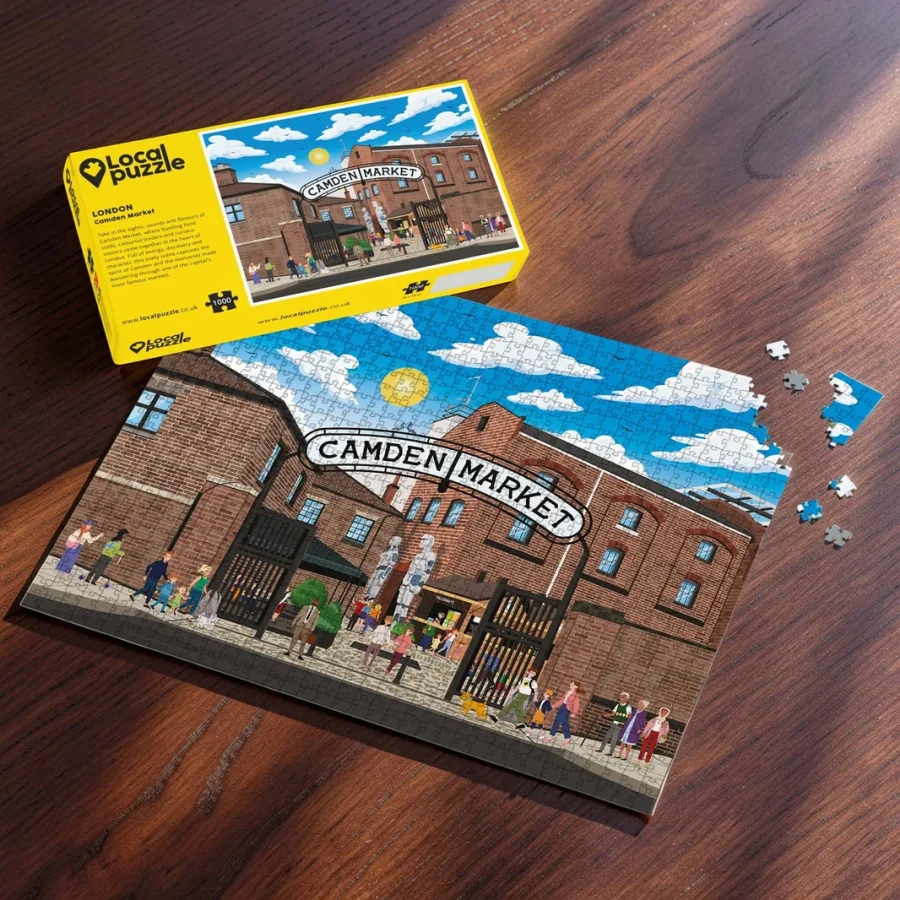
Next, imagine travelling north to the entrance of Camden market. Camden is known for variety—colour, pattern, and busy edges—and that range is perfect material for puzzle storytelling. As you work, you may notice how the architecture is less about grand symmetry and more about layered details: signs, awnings, walkway lines, and distinctive roof angles. The joy of 1000-piece London jigsaw puzzles in this setting is how they turn complexity into an orderly process. The puzzle doesn’t just show the market; it helps you learn how crowded scenes can still be built in logical stages. Before long, you’re not simply fitting random pieces; you’re recognising how the entrance frames the view and how the scene transitions from close-up textures to the wider street bustle.
From there, let your attention drift south to Borough market with view of The Shard. This is where the puzzle tour starts to feel truly cinematic. The Shard provides a strong vertical anchor, and strong verticals tend to make puzzle progress feel swift once you locate the right section. As you assemble the market in relation to that skyline feature, you gain a better sense of how London’s landmarks often coexist at different distances—street-level detail in the foreground, dramatic height in the background. Working with 1000-piece London jigsaw puzzles becomes a practice in perspective. You can almost feel the way your eyes would lift from stall signage to the skyline beyond. When the Shard finally snaps into place with its sharp edges and crisp highlights, the entire scene can suddenly click, as if you’ve reached the viewpoint you were heading for all along.
Leadenhall market is a wonderful next stop for this format because it is both intimate and grand, with its own distinctive rhythm of arches and passageways. A well-composed puzzle can capture that enclosed elegance through repeated shapes and repeating light patterns. You may find it calming to group similar pieces, as the market’s geometry gives your brain something steady to hold onto. With 1000-piece London jigsaw puzzles, the sense of structure is often enhanced because you have enough pieces to represent detail without losing the overall coherence. As you work, you begin to see how arches form a sequence, how shadows gather beneath them, and how the ceiling draws the eye inward. That “tour” feeling grows more vivid as the passage takes shape and you can imagine walking through it at a measured pace.
After Leadenhall, the atmosphere shifts again for Covent garden market/piazza. This is a place where people, street-level colour, and open space meet. In a puzzle, that combination can be a delight because large open areas allow you to spot gradients and lighting changes, while foreground details add small bursts of complexity. You might find yourself spending longer on the “in-between” zones—those softer areas where colours blend—because they can be harder to sort. Yet that’s exactly what makes 1000-piece London jigsaw puzzles so rewarding: the challenge isn’t only about brute searching, but about careful observation. Once you place the right piece in a blank-looking region, the whole scene brightens in a way you can instantly sense. By the time the piazza takes form, your living room begins to feel like a quiet corner of London where the buzz is present even when you’re seated and still.
Now, pivot to modern London with a stop at Tate modern. Art galleries and contemporary architecture can seem intimidating at first, but puzzles make them approachable by allowing you to translate bold massing and sleek surfaces into individual steps. The Blavatnik Building, in particular, offers strong shapes and a clear composition that can guide you. In 1000-piece London jigsaw puzzles, clean linework and architectural edges can become your map. As you match straight borders and identify consistent shading, you begin assembling a view that feels purposeful rather than decorative. This part of your tour may surprise you by how calm it feels; contemporary forms often contain fewer random small details than traditional streetscapes, so you can enjoy a steadier, more methodical pace.
From art to history, move on to the Natural history museum. This is where scale matters. Even when you’re working on a flat piece of cardboard, the exterior view can include a sense of grandeur: stonework, wide steps, and the unmistakable presence of dinosaur skeleton features. A puzzle can capture the way icons become landmarks, and it can also encourage you to look at details you might normally glance past. When 1000-piece London jigsaw puzzles include the outside with the dinosaur skeleton, the tricky bit often lies in matching texture—stone patterns, fine lines, and the skeletal shapes that may contain numerous small highlights. Yet as you assemble those bones and contours, you feel a gradual confidence, because the landmark is so recognisable. Eventually, you can step through the scene in your mind, remembering the museum’s atmosphere even though you’re still in the same chair.
Finally, come back across the river to the Millennium bridge looking towards St Paul’s cathedral. This is a fitting conclusion because it combines movement and alignment. Bridges naturally imply direction, and when your puzzle shows the Millennium bridge and looks towards St Paul’s cathedral, you’re presented with a powerful visual story: the bridge creates a pathway, and St Paul’s provides a distant goal. Working on this section in a “1000-piece London jigsaw puzzles” format feels like completing a journey. You’ll likely notice that the bridge has repeating elements, while the cathedral has more intricate shapes that reward careful sorting. Once you place the pieces that support the bridge’s lines, the view can feel like it opens up, and then, when St Paul’s begins to emerge properly, you’ll likely experience that satisfying “destination” moment.
It’s worth considering why this kind of tour works so well. London is a city of layers, and puzzles mirror that structure perfectly. There is the initial shock of complexity, then the gradual classification of edges, shapes, and colours, followed by the rewarding stage where you start predicting what the next piece should feel like. “1000-piece London jigsaw puzzles” are long enough to create a meaningful rhythm, and they’re also manageable enough for daily progress. In practice, that might mean working for a short period each evening, or saving a longer session for a weekend afternoon when you can fully sink into the scene.
As you carry out your tour, try to let each landmark suggest a different style of attention. Battersea power station may prompt you to focus on contrast. Camden market might encourage you to look for patterned clutter and framed viewpoints. Borough market invites you to align foreground and skyline. Leadenhall market encourages recognition of repeated architecture. Covent garden market/piazza draws out the subtleties of lighting and open space. Tate modern (Blavatnik Building) asks for respect of lines and clean geometry. The Facade of the Natural History Museum rewards perseverance with texture and bold silhouettes. And the Millennium bridge looking towards St Paul’s cathedral gives you a satisfying ending where direction and landmark meet.
When you finally complete your last section, the result is more than a picture. It’s a recap of attention, patience, and how your perception changes as pieces accumulate. You may also find that, after completing a puzzle tour like this, a real walk through London feels different. You’ll notice edges and angles more quickly. You’ll find yourself scanning for the way landmarks relate to one another, not only how they look in isolation. If you want to repeat the journey, you can return to earlier landmarks and re-imagine them in fresh detail, as if you were turning to a new page of the city.
It’s also a gentle reminder that exploration doesn’t have to be fast to be meaningful. A “1000-piece London jigsaw puzzles” tour can be done from your own table, yet still feel like travel—because the act of building a scene is, in its own way, a form of arriving.